Which Bank Has the Lowest UPI MDR Charges?
Published: 8 October 2026
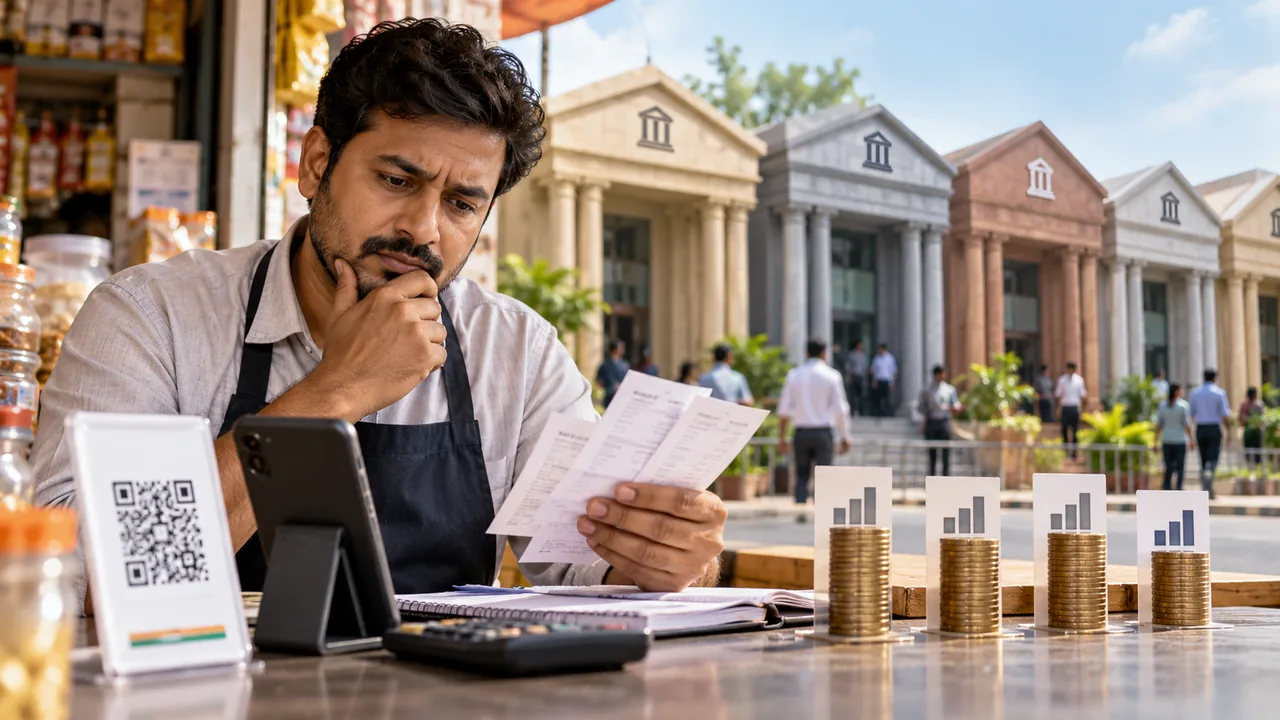
“Which bank has the lowest UPI MDR charges?” sounds like a normal comparison-shopping question. Merchants are used to comparing current-account fees, card-machine rentals and payment-gateway pricing, so it is natural to assume that UPI MDR works the same way.
That assumption is the problem. The 2026 UPI MDR framework does not publish a table where Bank A has one standard UPI MDR, Bank B has another and Bank C is the “cheapest.” The applicable treatment depends on the kind of UPI transaction, the merchant or account category and, in some cases, the merchant sector.
There Is No Official “Lowest MDR Bank” Ranking
For qualifying regular person-to-merchant (P2M) UPI payments above ₹2,000, the baseline MDR is 0.4%. Transactions of ₹75,000 and above are subject to the ₹300 maximum. Those figures come from the framework itself; they are not advertised as different standard rates chosen independently by each bank.
The Department of Financial Services under the Ministry of Finance set out the detailed structure in its September 2026 FAQs on MDR for select UPI P2M transactions. The document focuses on transaction type, merchant classification, thresholds and special categories. It does not identify a particular bank as offering the lowest UPI MDR.
Why Two Merchants Can Still See Different MDR Treatment
If the rate is not simply a bank-by-bank choice, why might two merchants appear to face different outcomes? Because the underlying transactions may not be in the same category.
Regular P2M Merchants
A qualifying regular P2M transaction above ₹2,000 falls under the baseline 0.4% structure unless a special category applies. At ₹10,000, for example, 0.4% is ₹40.
P2PM Small Merchants
A qualifying small vendor classified under the P2PM framework can remain at zero MDR while meeting the relevant monthly-receipt conditions. That means a small shop and a large commercial merchant could receive similar-looking UPI payments yet have different MDR treatment because their account classification is different.
If you need the small-merchant rules in detail, see Does UPI MDR Apply to a Small Shop?.
Special Merchant Categories
The framework also gives some sectors separate treatment. Covered insurance, fuel, railway and utility payments can use flat-fee structures above ₹2,000, while specified capital-market transactions have their own 0.02% rate capped at ₹300.
So a merchant comparing “rates” needs to ask first whether the payments being compared actually fall into the same category.
What a Merchant Should Compare Instead of “Lowest Bank MDR”
The better sequence is to identify the nature of the account and payment before looking for a lower price.
First, determine whether the merchant is P2M or P2PM. Second, check whether the payment is within a special merchant category. Third, apply the relevant transaction threshold and rate. The article Does UPI MDR Depend on Merchant Category? explains why the merchant category can change the result.
That approach avoids a common mistake: treating every charge that appears in a banking or payment-services agreement as if it were the MDR established by the UPI framework.
What About Other Bank or Payment-Service Charges?
A bank, payment aggregator or service provider may have commercial terms for products outside the specific MDR rule discussed here. Those terms should be identified by their actual name and contractual basis. It would be misleading to take an unrelated service charge and call it “the bank’s UPI MDR” without evidence that it is the MDR covered by this framework.
This distinction matters for merchants trying to compare providers. A cheaper current account, a lower device rental or a different payment-service package is not the same thing as a lower official UPI MDR rate.
Could Banks Ever Have Different UPI-Related Costs?
Possible service arrangements outside the framework should not be confused with the baseline MDR itself. The official material establishes the MDR structure discussed on this site; it does not provide a public competitive ranking of banks for the same qualifying UPI transaction.
That is why a search result claiming that one bank has “the lowest UPI MDR” should be checked carefully. The claim may actually be comparing another fee, a promotional commercial arrangement or a different payment product.
How to Read a Bank or PSP Pricing Page Without Mixing Up Charges
If a merchant compares providers, it helps to separate three layers. The first is the UPI MDR created by the regulatory framework. The second is any commercial service charge attached to an account, device or payment product. The third is a temporary offer or negotiated commercial arrangement. Only the first is the MDR discussed in these articles.
That distinction prevents a misleading comparison such as “Bank X charges 0.4% but Bank Y charges ₹299 a month, therefore Bank Y has lower MDR.” A monthly service plan and a per-transaction MDR are not the same type of charge.
When a provider page uses the word “merchant fee,” check what the fee is actually for, whether it applies to UPI, cards or another service, and whether it is describing the statutory UPI MDR or a separate commercial product. The safest comparison uses like-for-like charges.
Could a Merchant Save Money by Changing Categories?
Merchant categorisation is not something a business should manipulate just to obtain a lower MDR. P2PM exists for qualifying small vendors, and special rates exist for specified merchant categories. The category should reflect the actual merchant and transaction, not a label selected for pricing convenience.
That is why the practical answer to “which bank is cheapest?” is often to confirm the merchant classification first. A wrongly classified transaction can make any pricing comparison meaningless.
Bottom Line
There is no official list naming one bank as the bank with the lowest UPI MDR. For the 2026 framework, the more useful question is: what type of merchant and transaction is this?
Once that is known, the relevant MDR rule can be applied. For a regular qualifying P2M payment above ₹2,000, that may mean the 0.4% baseline. For a P2PM small merchant or a special merchant category, the outcome can be different. The difference comes from the framework and classification, not from a simple “cheapest bank” table.