Merchant Charges for a UPI Credit Card Payment
Published: 7 October 2026
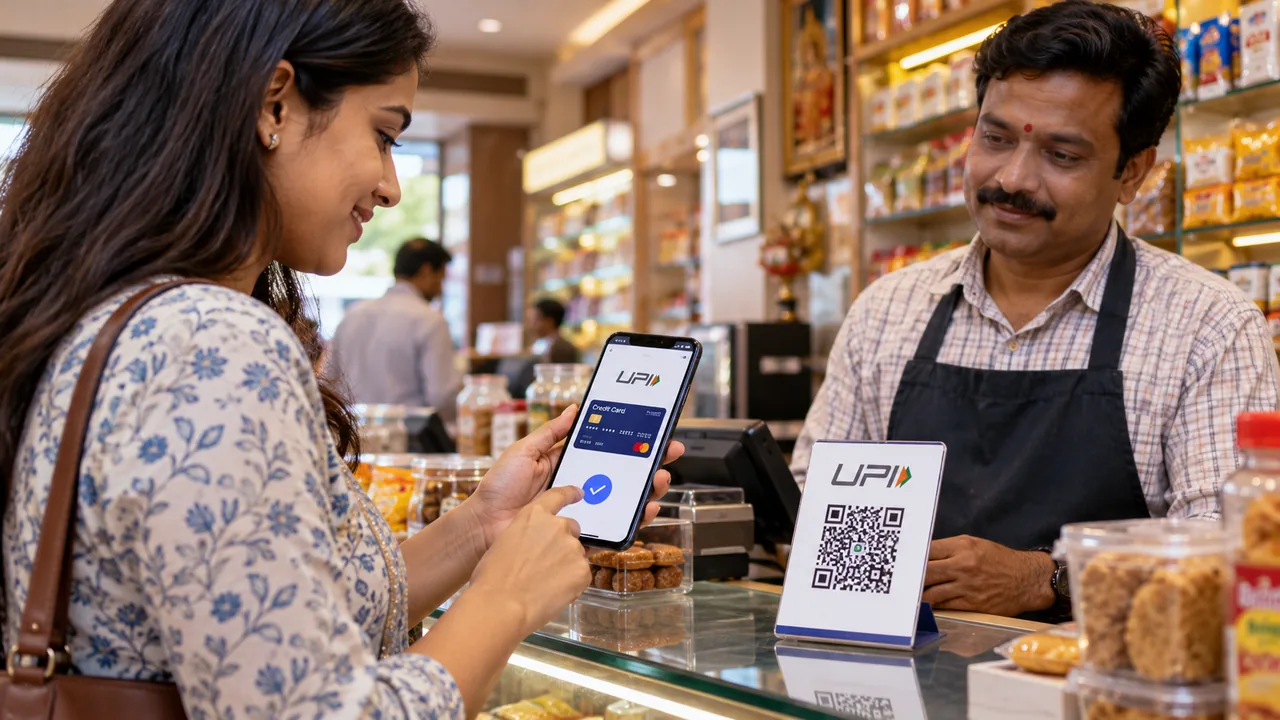
Merchant charges for a UPI credit card payment are not the new 0.4% UPI MDR. A shop asking what it pays when a customer uses a credit card on UPI is asking about the card, not the bank-account rule. If the customer pays from a savings account, the shop may be on 0.4% from 15 October 2026. If the customer pays with a RuPay credit card through the UPI app, the shop is on the card schedule in the acquirer’s notice.
The screen looks the same. The customer opens PhonePe, Google Pay or Paytm, picks the shop QR, and enters a UPI PIN. The funding account is the difference. A bank account is the 0.4% rule. A credit card, or a pre-approved credit line, is a card payment that travelled over UPI. NPCI’s September FAQ put those credit payments outside the 0.4% table.
Two Payments at One Counter
A furniture shop takes ₹20,000. The first customer pays from a savings account. On a standard merchant handle, 0.4% is ₹80, and the customer still pays ₹20,000. The second customer pays with a RuPay credit card linked in the same app. The shop should not assume another ₹80. Card MDR is often in the 1.5% to 2.5% range that NPCI has quoted for credit cards generally. One bank’s merchant notice, Canara Bank’s September 2026 note, put RuPay credit on UPI above ₹2,000 at category rates, and at 1.93% with no ₹300 cap for codes outside its industry list, plus GST on that fee. Your number is the notice from your own bank.
- Account-funded UPI above ₹2,000: 0.4% on a standard shop, ₹300 cap from ₹75,000.
- RuPay credit on UPI above ₹2,000: card MDR, not 0.4%, and not automatically capped at ₹300.
- Either payment at ₹2,000 or below: check the notice. The 0.4% rule does not apply under ₹2,000. Card plans can still differ.
- A small P2PM QR is a zero-MDR class for account payments within ₹1 lakh a month. Do not assume the same zero on a credit-card swipe through UPI.
What the Shop Should Read on the Settlement
Ask the acquirer for two lines, not one. Account UPI and credit-card UPI should not be priced as the same product. A clinic that sees ₹80 missing on a ₹20,000 account payment is in the 0.4% world. The same clinic seeing ₹386 missing on a ₹20,000 credit-card UPI payment is in the card world, if 1.93% is the agreed rate. GST, where the bank adds it, sits on the fee. It is not a second percentage on the bill.
A customer asking “will I be charged for using my credit card on UPI?” is a different question. The published customer rule is still that the person pays the amount on the screen. The merchant charge is the shop’s cost. A shop that adds 2% only when the app shows a credit card is adding its own surcharge. That is not the card MDR, and it is not the 0.4% rule either.
Whether a RuPay credit payment sits under the 0.4% table at all is covered in RuPay credit card UPI payments and the 0.4% MDR. This note is the merchant price after that answer: card rate, your MCC, your bank’s annexure, GST on the fee. Until the acquirer sends the annexure, do not quote 0.4% to a customer who paid by credit card on UPI.
A supermarket can turn credit-card UPI off and keep account UPI on. That is an acquirer setting, not a new QR. If the owner does not want a 2% fee on a television, the practical step is to ask the bank to decline credit on that handle, and to tell the cashier to ask which account the customer is paying from. Guessing from the app logo will get the settlement wrong.