What Happens If a Small Merchant Crosses ₹1 Lakh in UPI Payments?
Published: 8 October 2026
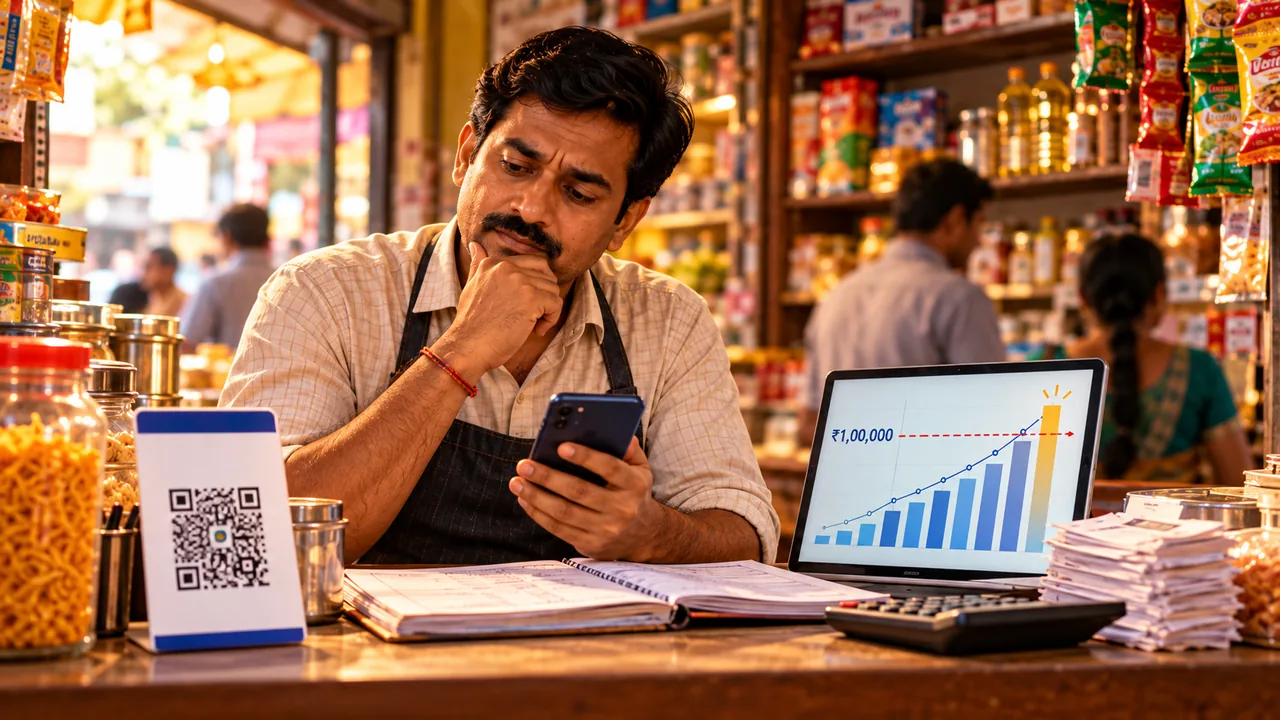
The ₹1 lakh figure in the small-merchant UPI MDR rules is often misunderstood as an instant switch: cross ₹1 lakh once and MDR immediately starts. That is not how the transition rule is described.
For P2PM merchants, the framework looks at monthly inward UPI receipts and uses a three-consecutive-month test before formal transition to P2M.
What the ₹1 Lakh Threshold Actually Measures
The ₹1 lakh figure is a monthly receipt threshold for the P2PM small-merchant framework. It is not a maximum amount for one transaction and it is not a daily UPI limit.
Qualifying small merchants receiving up to ₹1 lakh per month through UPI QR into the relevant account can remain within the zero-MDR P2PM category.
Crossing ₹1 Lakh Once Is Not the Formal Transition Trigger
The Department of Financial Services explains in its September 2026 UPI MDR FAQs that acquiring banks and PSPs monitor inward receipts for P2PM merchants. Formal transition to P2M takes place when the merchant exceeds ₹1 lakh per month for three consecutive months.
That wording matters. A single busy month is not described as the formal reclassification trigger.
Why the Three-Month Test Is Important
Small businesses can have irregular sales. A festival season, wedding order, seasonal inventory cycle or one exceptional month can push receipts above the normal level.
The three-consecutive-month rule creates a way to distinguish a temporary spike from a merchant whose UPI collections have grown beyond the intended P2PM scale.
Example: One Month Above ₹1 Lakh
Suppose a merchant receives ₹1.15 lakh in UPI QR payments in October but drops back to ₹85,000 in November and ₹90,000 in December.
Based on the stated three-consecutive-month transition rule, that sequence does not satisfy the condition of exceeding ₹1 lakh per month for three consecutive months.
Example: Three Consecutive Months Above ₹1 Lakh
Now suppose inward UPI receipts are ₹1.10 lakh in October, ₹1.20 lakh in November and ₹1.18 lakh in December. That meets the described pattern for formal transition from P2PM to P2M.
Once the merchant is formally moved into P2M, the regular MDR framework becomes relevant for qualifying transactions, subject to any applicable special merchant-category rule.
Does a Single Large Payment Above ₹2,000 Trigger 0.4% MDR?
Not by itself for an otherwise qualifying P2PM merchant. Merchant categorisation and the monthly P2PM rules still matter. A large individual bill does not automatically erase the small-merchant exemption.
This point is important because it separates two thresholds that serve different purposes: ₹2,000 is the baseline transaction threshold for qualifying regular P2M payments, while ₹1 lakh is a monthly-receipt threshold used in the P2PM merchant framework.
What Role Do Banks and PSPs Play?
The official FAQs say acquiring banks and PSPs monitor the inward threshold. The rule therefore depends on the merchant’s account categorisation and receipt history rather than on a merchant manually declaring a new category after one busy month.
The exact operational implementation should not be invented beyond what the published framework states. The firm point is the monitoring of the monthly threshold and the three-consecutive-month transition rule.
Does GST Registration Decide the Outcome?
No. GST registration is not the eligibility test for zero MDR under P2PM. The framework looks to monthly collections and account categorisation. See Can a Small Merchant Get Zero UPI MDR Without GST Registration?.
Do Refunds, Reversals or Other Adjustments Change the Monthly Test?
The published FAQ gives the monthly inward threshold and the three-consecutive-month transition rule, but it does not provide enough detail to invent a universal accounting method for every reversal, refund or settlement adjustment. Those operational questions should be answered from authoritative implementation guidance rather than assumption.
For content on this site, the safer rule is to stick to what is confirmed: acquiring banks and PSPs monitor inward UPI receipts, and three consecutive months above ₹1 lakh trigger formal transition.
Why Merchants Should Track Monthly UPI Receipts Separately
Even without speculating about bank systems, the rule makes monthly receipts an important business metric. A merchant consistently approaching ₹1 lakh should understand that the P2PM category is designed for small-scale collections and that sustained growth can lead to P2M treatment.
That does not mean merchants should split transactions or manipulate accounts to remain below the threshold. The framework is based on genuine merchant categorisation and monitored receipt patterns.
Bottom Line
A small merchant does not formally move from P2PM to P2M merely because UPI receipts cross ₹1 lakh once. The official rule looks for receipts above ₹1 lakh per month for three consecutive months. That is the point at which the framework provides for formal transition to P2M.