Do Rural and Semi-Urban Merchants Pay UPI MDR?
Published: 8 October 2026
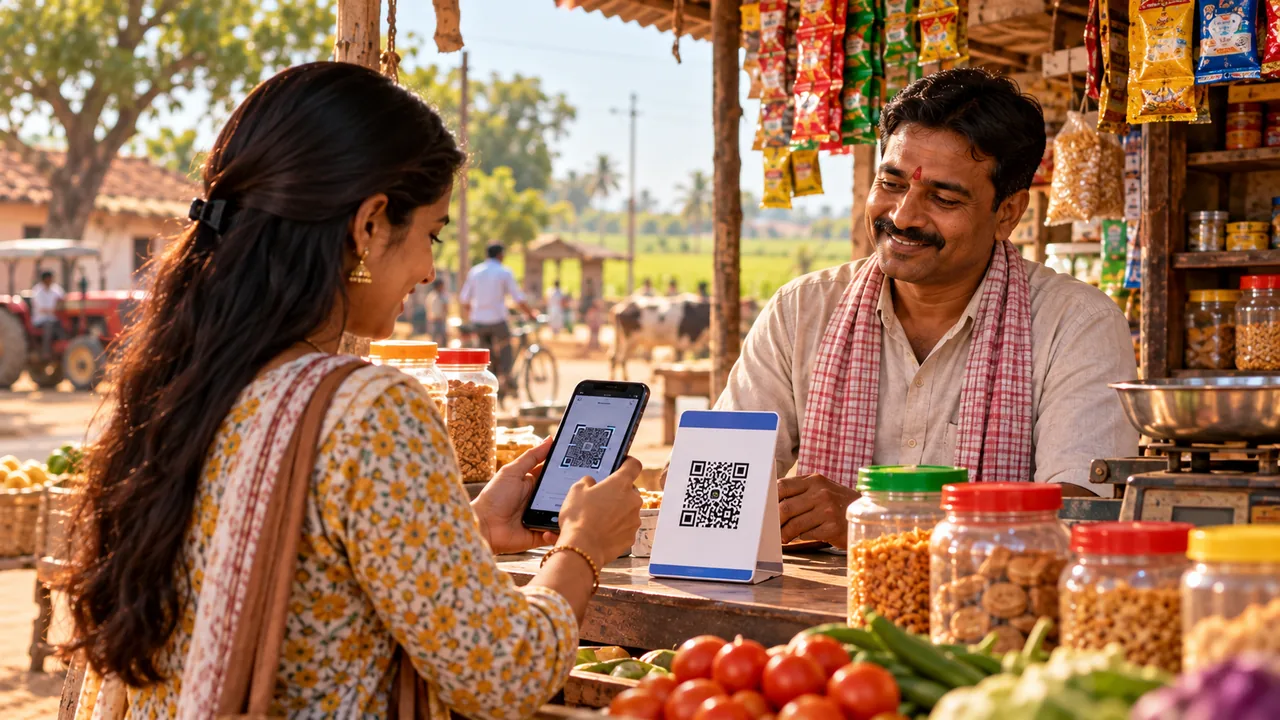
A shop in a village or small town does not automatically pay UPI MDR, but it is equally inaccurate to say that every merchant outside a major city is exempt. Geography is not the only test.
The important concept is P2PM: the small-merchant framework that can keep qualifying UPI QR payments at zero MDR.
What the Framework Says About Rural and Semi-Urban Merchants
The September 2026 UPI MDR FAQs from the Department of Financial Services specifically address QR payments accepted by P2PM merchants in rural and semi-urban areas and state that the zero-MDR treatment continues for qualifying merchants.
That protection is intended to support small vendors and continued digital-payment acceptance.
Location Alone Does Not Create the Exemption
A large enterprise does not become a P2PM small merchant merely because one outlet operates in a rural area. The official wording ties the zero-MDR treatment to P2PM classification and the small-merchant framework.
That distinction prevents a misleading simplification such as “all village merchants pay zero MDR.”
What Is the P2PM Threshold?
Qualifying small merchants receiving up to ₹1 lakh per month through UPI QR can remain within the zero-MDR P2PM structure.
The threshold is monthly. It is not a ₹1 lakh limit on a single payment and it is not the same as the customer’s UPI transaction limit.
What If a Rural Merchant Grows Beyond the Threshold?
The framework anticipates that a small merchant can grow. Acquiring banks and PSPs monitor inward UPI receipts, and a merchant exceeding ₹1 lakh per month for three consecutive months is formally transitioned to P2M.
Once that transition occurs, qualifying payments can fall under the regular P2M MDR structure unless a special merchant-category rule applies.
Does One Large QR Payment End Zero MDR?
Not by itself. The P2PM protection is linked to the merchant’s classification and monthly receipt conditions. A single payment above ₹2,000 does not automatically impose the standard 0.4% MDR on an otherwise qualifying P2PM merchant.
This is particularly important for seasonal rural businesses, where one high-value transaction may not reflect the merchant’s normal monthly scale.
What About Semi-Urban Shops With GST Registration?
GST registration is not required to qualify for zero MDR under P2PM, and the official FAQ does not make GST status the deciding test. The relevant factors are the merchant’s P2PM categorisation and monthly UPI receipts.
See Can a Small Merchant Get Zero UPI MDR Without GST Registration? for that issue.
Why This Is Different From a Geographic Subsidy
The rule should not be described as a blanket “rural MDR waiver.” It sits inside the P2PM small-merchant framework. The geography appears in the official discussion, but the protection is still connected with the merchant category.
That wording matters for accuracy and for merchants trying to understand whether the rule applies to them.
Why Rural Merchants Were Addressed Explicitly
Small vendors in rural and semi-urban markets are an important part of UPI adoption. A broad MDR applied without protection could discourage merchants with thin margins from accepting digital payments, so the P2PM framework is designed to preserve zero-MDR acceptance for qualifying small merchants.
The policy therefore recognises the reality that a small QR-accepting vendor and a large enterprise do not necessarily need identical treatment.
What Happens if the Same Business Has Multiple Locations?
The official FAQ does not give enough detail to create a universal rule for every multi-location business structure. It would be unsafe to say that one rural outlet automatically makes the entire enterprise P2PM or that every outlet must be treated separately.
Where the merchant structure is complex, the actual account categorisation should be confirmed rather than inferred solely from the physical location of one shop.
Example: Small Village Shop Versus Large Rural Outlet
Imagine a neighbourhood shop in a semi-urban area that is properly classified as P2PM and receives ₹65,000 in monthly UPI QR payments. The small-merchant zero-MDR framework can apply. Now compare that with a large retail outlet in the same town that operates as a regular P2M merchant. The fact that both are in the same geographic area does not force them into the same MDR treatment.
The example shows why location is context, not the complete eligibility test.
What Merchants Near the Threshold Should Watch
A rural or semi-urban merchant whose digital sales are growing should pay attention to monthly inward UPI receipts. Sustained growth above ₹1 lakh per month for three consecutive months is the transition condition described for movement to P2M.
This allows a genuine small merchant to benefit from zero MDR while providing a defined path for larger or growing merchants to move into the regular framework.
Bottom Line
Qualifying P2PM merchants in rural and semi-urban areas can continue to accept UPI QR payments at zero MDR while they remain within the prescribed small-merchant conditions. The exemption comes from P2PM classification, not from geography alone.