Is UPI MDR a Tax or Government Charge?
Published: 8 October 2026
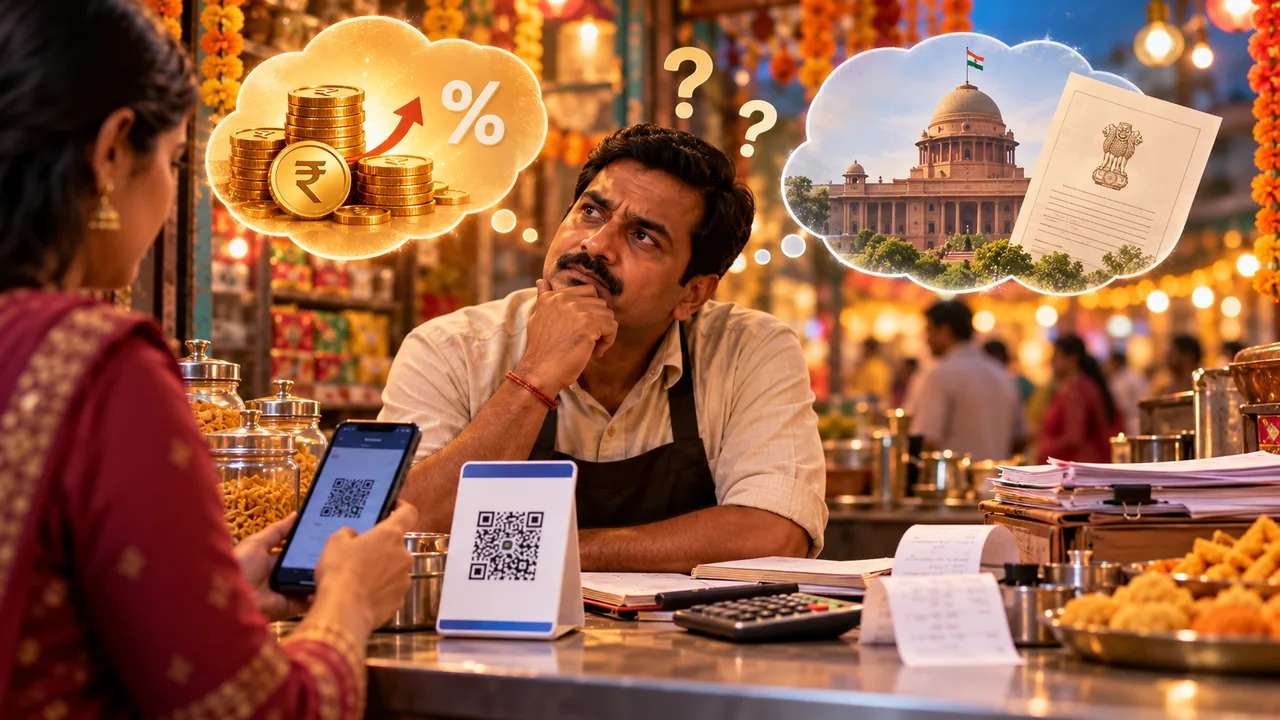
The announcement of a new payment charge often leads to an immediate assumption: if the government introduced the framework, the charge must be a new tax. In the case of UPI MDR, that conclusion is incorrect.
The government has explicitly clarified that MDR is neither a tax nor a charge collected by the Government or NPCI.
What MDR Actually Is
MDR stands for Merchant Discount Rate. In the 2026 UPI framework, it is a merchant-side payment charge on covered transactions.
The government’s September clarification describes the MDR as being distributed among participants in the payment ecosystem, including banks and payment application providers, to support the operation and continued expansion of UPI.
Why “Government Charge” Is the Wrong Label
The Department of Financial Services under the Ministry of Finance established the policy framework, but establishing a rule and collecting the charge are different things.
The official clarification specifically rejects the idea that the MDR is money collected by the Government. Calling it a “0.4% government tax on UPI” therefore misstates the nature of the charge.
Is It an NPCI Fee?
The same clarification also says MDR is not a charge collected by NPCI. NPCI plays a central role in the UPI ecosystem and in the operational governance of the framework, but that does not mean the entire MDR is simply paid to NPCI.
For that misconception specifically, see Where the 0.4% UPI MDR Goes After 15 October 2026.
Who Bears the MDR?
MDR is a merchant-side cost for covered merchant transactions. Consumers continue to use UPI without a transaction charge, and merchants are not supposed to add the MDR to the buyer’s bill as an extra UPI surcharge.
The detailed explanation is in Who Pays UPI MDR Charges: Merchant or Customer?.
Does “Not a Tax” Mean Tax Questions Never Arise Around Payment Charges?
No. Saying that MDR itself is not a government tax does not answer every possible tax-treatment question involving payment-service charges, merchant accounting or GST.
Those are separate issues and should be addressed only with the relevant tax authority or official guidance. The narrow point here is that the UPI MDR itself is not the new government tax some users assume it to be.
Why the Distinction Matters
Calling MDR a tax changes how people understand the policy. A tax is generally a compulsory levy collected by government. The UPI MDR is instead described as a payment-system merchant charge used within the ecosystem.
That difference also explains why the framework contains merchant categories, special rates and exemptions rather than a single tax applied to all UPI users.
Example
Suppose a qualifying regular merchant receives a ₹10,000 UPI payment. The baseline MDR calculation is ₹40. That ₹40 should not be described as “₹40 tax paid to the government.” It is the applicable merchant-side MDR under the payment framework.
Why People Call It a Tax Even Though It Is Not One
The confusion is understandable because the rule was announced through government policy and applies broadly across a national payments system. But a government-created regulatory framework can govern a commercial charge without turning that charge into tax revenue.
The official clarification removes the ambiguity by directly stating that the MDR is not a tax and is not collected by the Government or NPCI.
Why the Word “Tax” Can Distort Other MDR Questions
Once MDR is incorrectly described as a tax, other explanations become confused too. People may ask whether the tax is refundable, whether it goes to the government or whether customers must pay it. Those questions start from the wrong premise.
Calling the charge by its correct name—Merchant Discount Rate—keeps the discussion focused on the merchant-payment framework and the applicable transaction categories.
How MDR Differs From a Government Levy in Practice
A government levy is ordinarily collected under a tax or statutory charging mechanism for public revenue. The UPI MDR described in the 2026 framework is instead connected with the cost of processing merchant payments and supporting the payment ecosystem.
That is why the official clarification can simultaneously say the Government established the framework and that the charge is not collected by the Government.
Why the “Tax” Label Can Mislead Merchants
If a merchant thinks MDR is a tax, it may expect a government challan, tax slab or direct remittance to a public authority. None of those assumptions follows from the official description of the charge.
The merchant should instead understand MDR as part of the payment acceptance framework, with different treatment for regular P2M, P2PM small merchants and special sectors.
Bottom Line
UPI MDR is not a tax and is not a charge collected by the Government or NPCI. It is a merchant-side payment charge within the UPI ecosystem for covered transactions. Describing it as a new government tax or an NPCI tax is therefore inaccurate.