How Does the ₹300 UPI MDR Cap Work?
Published: 8 October 2026
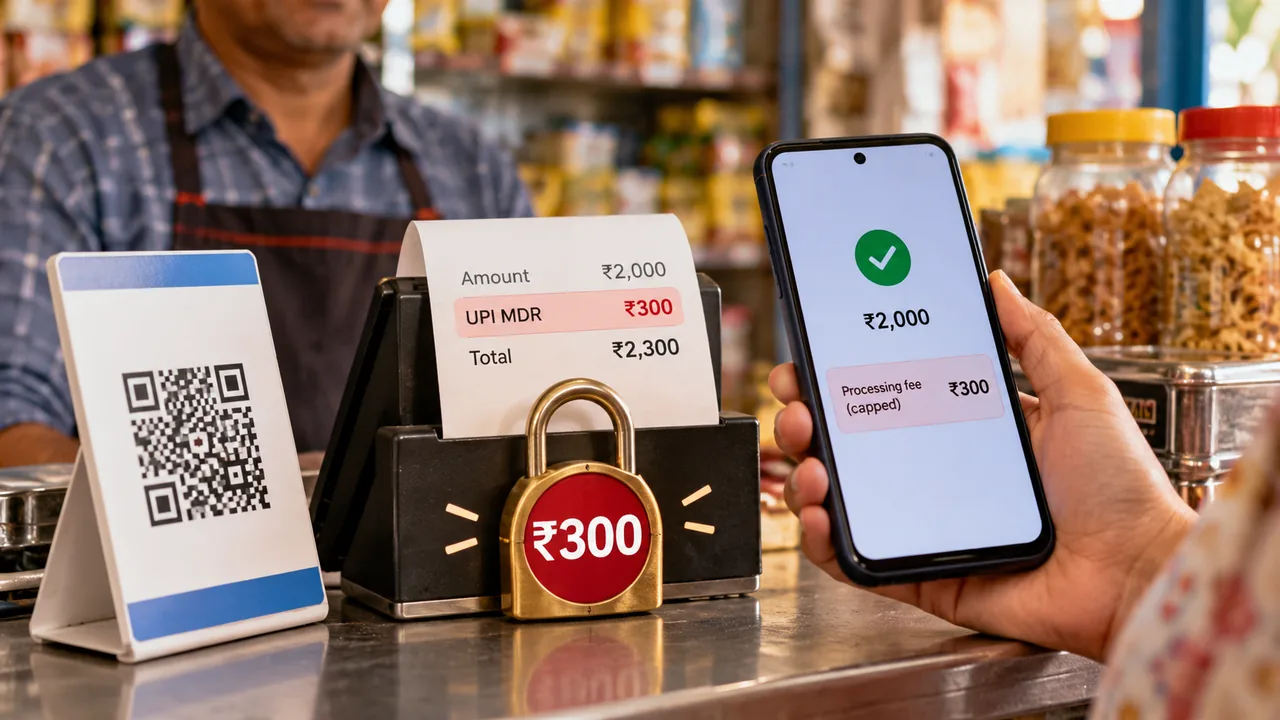
The standard UPI MDR rule is often summarised as “0.4% above ₹2,000.” That summary is incomplete because it leaves out one of the most important protections in the framework: the ₹300 maximum for qualifying regular P2M transactions of ₹75,000 and above.
Without the cap, the MDR would continue increasing as the transaction value rises. With the cap, it stops at ₹300.
Why ₹75,000 Is the Key Point
At the baseline rate of 0.4%, a ₹75,000 transaction produces exactly ₹300:
₹75,000 × 0.004 = ₹300
That is why ₹75,000 is the point at which the standard calculation reaches the cap. The Department of Financial Services’ September 2026 FAQs state that transactions of ₹75,000 and above are capped at ₹300 per transaction.
What Happens Below the Cap?
For qualifying regular P2M transactions above ₹2,000 but below ₹75,000, the MDR is calculated at 0.4%.
| Transaction | 0.4% Calculation | Applicable MDR |
|---|---|---|
| ₹3,000 | ₹12 | ₹12 |
| ₹10,000 | ₹40 | ₹40 |
| ₹50,000 | ₹200 | ₹200 |
| ₹75,000 | ₹300 | ₹300 |
Those examples follow the standard baseline structure. They should not be applied blindly to a transaction that belongs to a special merchant category or an exempt small merchant.
What Happens Above ₹75,000?
Once the transaction reaches the capped band, the arithmetic 0.4% amount can be higher than ₹300, but the applicable MDR remains ₹300.
| Transaction | 0.4% Without Cap | MDR After Cap |
|---|---|---|
| ₹1,00,000 | ₹400 | ₹300 |
| ₹2,00,000 | ₹800 | ₹300 |
| ₹5,00,000 | ₹2,000 | ₹300 |
The cap therefore becomes increasingly important as the transaction value rises.
Does the ₹300 Cap Mean Every ₹75,000 UPI Payment Costs ₹300?
No. This is where merchant categorisation matters.
The standard cap belongs to the qualifying regular P2M structure. A P2PM small merchant that remains within the zero-MDR framework is not automatically moved to ₹300 simply because one payment is ₹75,000. Similarly, special merchant categories can have separate rates.
See Does UPI MDR Depend on Merchant Category? before applying the cap to a payment whose classification is uncertain.
What About Mutual Funds and Stocks?
Covered capital-market transactions also have a ₹300 maximum, but they use a different rate: 0.02% of transaction value. At that rate, ₹300 is reached only at ₹15,00,000.
That is a separate calculation from the standard 0.4% structure. The full explanation is in UPI MDR on Mutual Funds and Stocks: What Is the Charge?.
Is the Cap a Customer Fee?
No. The ₹300 figure is the maximum merchant-side MDR under the relevant standard rule. It is not a flat ₹300 fee that should be added to the customer’s UPI payment.
Why the Cap Matters for High-Value Payments
A percentage rate without a cap can become large very quickly. At 0.4%, a ₹5 lakh transaction would mathematically produce ₹2,000. The ₹300 ceiling prevents that outcome under the standard P2M framework.
This is one reason a simple percentage calculation is not enough for high-value payments. The merchant must apply both the rate and the cap.
Why the Cap Should Be Checked After the Percentage Calculation
A useful way to think about the standard calculation is in two steps. First calculate 0.4% of the qualifying transaction value. Then compare that result with the ₹300 maximum. If the percentage amount is below ₹300, use the percentage result. If it is above ₹300, the cap limits the applicable MDR to ₹300.
This two-step method avoids a common mistake where a merchant simply multiplies every large transaction by 0.4% and forgets to apply the ceiling.
The Cap Does Not Change the Rate Below ₹75,000
Another mistake is to treat ₹300 as a flat fee for all higher-value payments. It is not. Below ₹75,000, the ordinary 0.4% calculation still matters. A ₹50,000 payment is ₹200, not ₹300. The cap only becomes binding once the percentage calculation reaches the maximum.
That makes the ₹75,000 point important because it is where the percentage result and the cap meet exactly.
Common Mistakes With the ₹300 Cap
One common error is to apply ₹300 to every payment once the merchant knows there is a cap. The cap is a ceiling, not a flat fee. A ₹20,000 qualifying regular P2M payment is still calculated at 0.4%, which is ₹80. The ₹300 maximum does not matter until the percentage result reaches that amount.
Another error is to keep multiplying by 0.4% after ₹75,000 and report the larger number as the MDR. For example, ₹2 lakh at 0.4% is ₹800 mathematically, but the applicable standard MDR is ₹300 because the ceiling has already been reached.
A third mistake is to use the standard cap for a transaction that belongs to another category. A capital-market payment also has a ₹300 maximum, but it reaches that maximum under a different 0.02% rate. Flat-fee categories such as insurance or covered utilities do not use this standard percentage-and-cap calculation at all.
Bottom Line
For a qualifying regular P2M payment, 0.4% applies above ₹2,000 until the calculation reaches ₹300. That happens at ₹75,000. From ₹75,000 upward, the applicable MDR is capped at ₹300 rather than continuing to rise with the transaction value.