Are All UPI Merchant Payments Above ₹2,000 Charged MDR?
Published: 8 October 2026
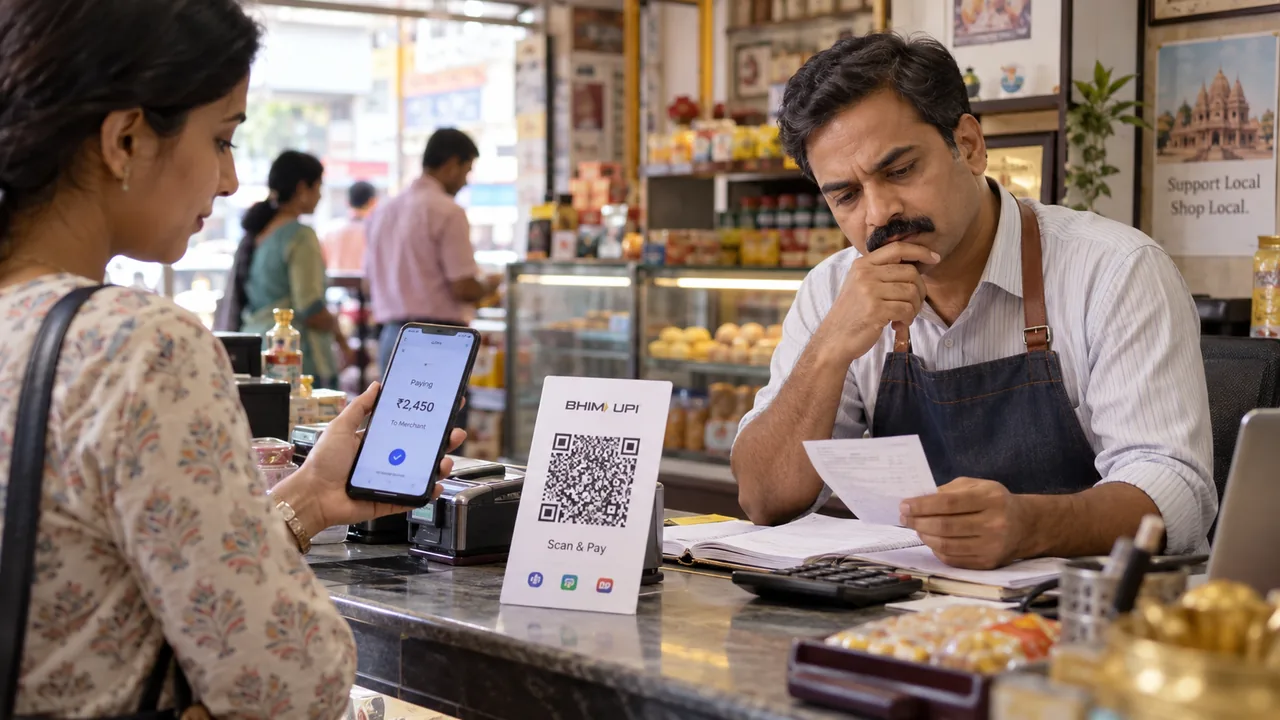
“UPI MDR is 0.4% above ₹2,000” is a useful headline, but it becomes misleading if it is treated as a universal rule for every merchant payment.
Not all UPI merchant payments above ₹2,000 are charged the standard 0.4% MDR. The transaction and merchant category still have to be identified.
When the Standard 0.4% Rule Applies
For qualifying regular P2M transactions above ₹2,000, the baseline MDR is 0.4%, with the ₹300 maximum for transactions of ₹75,000 and above.
The Department of Financial Services’ September 2026 FAQs also set out exemptions and special-category rules that can produce a different result.
Small P2PM Merchants Can Remain at Zero MDR
A qualifying small merchant under P2PM does not automatically move into the 0.4% structure because one payment is above ₹2,000.
The P2PM rule is based on merchant/account categorisation and monthly inward UPI receipts. The framework uses a ₹1 lakh monthly threshold and a three-consecutive-month transition test.
See Does UPI MDR Apply to a Small Shop? for the complete small-merchant explanation.
Some Sectors Use a Flat ₹5 Instead
Covered insurance, fuel, railway and specified utility payments can use a flat ₹5 MDR above ₹2,000 rather than 0.4%.
That means a ₹10,000 payment in one of those covered categories can have an MDR of ₹5 rather than ₹40.
Capital-Market Payments Use a Separate Rate
Covered capital-market transactions, including specified mutual-fund and securities-related payments, use a 0.02% MDR capped at ₹300.
The separate calculation is covered in UPI MDR on Mutual Funds and Stocks: What Is the Charge?.
UPI Mandates and AutoPay Are Addressed Separately
The official framework states that recurring UPI Mandates and AutoPay standing instructions do not carry the prescribed MDR transaction charges.
So a recurring payment above ₹2,000 should not automatically be treated as an ordinary one-time P2M payment merely because the value crosses the threshold.
Exactly ₹2,000 Is Still Zero MDR Under the Baseline Rule
The wording is “above ₹2,000.” A qualifying regular P2M payment of exactly ₹2,000 remains at zero MDR.
This boundary is explained in UPI Merchant Charges on Payments Above ₹2,000.
Why Merchant Category Comes Before the Calculator
A calculator can only produce the right answer after the correct rate has been selected. If a user enters ₹10,000 and assumes 0.4% without checking the category, the arithmetic can be perfect and the result still wrong.
That is why merchant classification and special-category rules are not minor exceptions—they are part of the calculation itself.
A Quick Comparison
| Example Category | Payment | Illustrative Treatment |
|---|---|---|
| Qualifying regular P2M | ₹10,000 | 0.4% = ₹40 |
| Covered insurance | ₹10,000 | Flat ₹5 |
| Covered capital-market payment | ₹10,000 | 0.02% = ₹2 |
| Qualifying P2PM small merchant | Above ₹2,000 | Can remain zero MDR |
Why “0.4% Above ₹2,000” Is Still a Useful Shortcut
The shorthand is useful when the context is clearly a qualifying regular P2M merchant payment. The problem begins when the context disappears and the sentence is repeated as though it describes every UPI transaction.
A better formulation is: the baseline MDR for qualifying regular P2M transactions above ₹2,000 is 0.4%, subject to the ₹300 cap, while exemptions and special categories have different treatment.
How to Check a Payment Before Applying 0.4%
Ask three questions in order. Is this a merchant transaction rather than P2P? Is the merchant in regular P2M or an exempt P2PM category? Does a special sector rule apply? Only after those questions are answered should the percentage calculation be used.
This sequence is more reliable than starting with the payment amount alone.
Examples That Show Why “All” Is the Wrong Word
A ₹5,000 payment to a qualifying regular P2M merchant can produce ₹20 at the baseline 0.4% rate. A ₹5,000 covered insurance payment uses ₹5. A ₹5,000 payment to a qualifying P2PM small merchant can remain at zero MDR. A ₹5,000 covered capital-market payment at 0.02% gives ₹1.
All four payments are above ₹2,000, yet they do not have the same MDR outcome. The examples make the limitation of the headline rule obvious.
Why Search Intent Still Makes This a Useful Question
People naturally simplify new rules into yes-or-no questions. “Are all payments above ₹2,000 charged?” is therefore a valuable search query even though the correct answer is no.
A good explainer should answer the misconception directly and then show the categories that change the result, rather than simply repeating the 0.4% headline.
Bottom Line
No, not every UPI merchant payment above ₹2,000 is charged the standard 0.4% MDR. The correct answer depends on the merchant or transaction category, the P2PM exemption where relevant, special sector rates and whether the payment is a recurring mandate.